
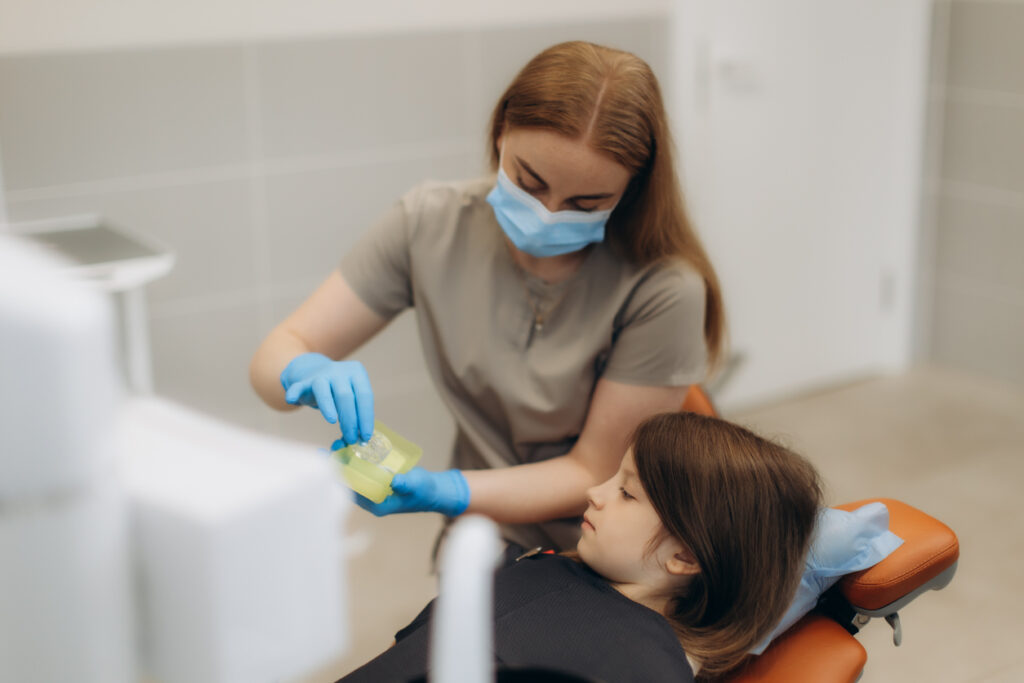
Early cavity detection is the clinical process of identifying incipient caries, the earliest stage of tooth decay, in which mineral loss occurs but no physical hole has formed yet. At Azalea Dental, we use digital X-rays and intraoral cameras to detect these microscopic weak spots, often allowing reversal through remineralization without the need for a drill. Clinical literature supports that remineralization treatment, which is non-invasive, is increasingly being used to treat incipient enamel caries [1] (Hayashi et al., 2020).
Understanding Incipient Caries
Decay begins as a chalky, “white spot” lesion. This is known as incipient caries. Medical evidence supports that White spot lesions are a common unwanted outcome of orthodontic treatment that can be minimized with proper oral hygiene [2] (Prada et al., 2024). At this stage, the surface of your enamel is still intact, but the minerals underneath have been leached away by acid-producing bacteria. Because these spots are usually painless and hidden in the grooves of your molars or between teeth, they are invisible to the naked eye. During a routine exam at Azalea Dental, we look for these specific changes in color and texture. Catching decay at the white spot stage is ideal in preventive dentistry because the tooth has not actually “broken” yet, leaving time for a non-invasive repair.
A table that compares early detection and reactive care
Feature | Early detection | Late detection |
Symptoms | None | Sharp pain, hot and cold sensitivity |
Treatment | Remineralization or micro-filling | Root canal, crown, extraction |
Procedure time | 15-30 minutes | Multiple 90-minute visits |
Cost impact | Low | High |
Durability | Preserves 99% of the natural tooth | Requires artificial replacement |
The Power of Remineralization
The most exciting part of early cavity detection is the possibility of remineralization therapy. When we find a cavity in its infancy, Dr. Barbaro may opt to “heal” the tooth rather than drill. By applying professional-grade fluoride varnishes or calcium-phosphate treatments, we can physically redeposit minerals back into the porous enamel. Clinical evidence indicates that the highest level of primary tooth remineralization occurs with 5% sodium fluoride varnish as an effective preventive treatment [3] (Poovelil et al., 2025). This process hardens the weak spot and stops the decay. This is a game-changer for our patients in Wilmington who want to preserve as much of their natural tooth structure as possible. It transforms the dental visit from a “repair mission” into a “recovery mission.”
The Shift to Digital Micro-Diagnostics
In the past, dentists relied on a sharp metal tool called an “explorer” to poke at teeth. If the tool gets stuck in a soft spot, a cavity is present. However, by the time a cavity is large enough for a metal tool to adhere, the damage is already significant. At Azalea Dental, we have moved beyond explorers. We use digital diagnostic mapping and high-definition intraoral cameras to detect changes in enamel density. This technology allows us to see the microscopic “shadows” of decay that a metal explorer would simply glide over.
Finding Decay Where Floss Cannot Reach
One of the most dangerous cavities is the one that hides interproximally, or between the teeth. Because the enamel is thickest on the biting surfaces but thinnest between the teeth, decay can travel to the nerve much faster in these hidden gaps. This is why our bitewing X-rays are so critical during your bi-annual visit. The medical literature supports the view that Bitewing X-rays offer a significant advantage over periapical radiographs in diagnosing the early stages of interproximal carious lesions [4] (Takahashi et al., 2019). These digital images can display the tight spaces your floss might miss. Finding a millimeter-sized spot between your teeth today prevents a massive, painful fracture tomorrow while you’re out enjoying dinner in downtown Wilmington.
How Early Detection Protects Your Household Budget
If you skip a routine exam, a $50 fluoride treatment becomes a $250 filling. If the filling is delayed, it becomes a $1,000 root canal. If the root canal fails, you’re looking at a $4,000 dental implant. Early detection provides a massive Financial ROI. By investing 45 minutes at our office twice a year, you are effectively choosing the lowest possible price for your dental health. Whether you are a parent or busy professional, catching decay early is an effective way to ensure your hard-earned money stays in your savings account rather than being spent on avoidable oral surgery.
FAQS
1. Can a cavity really be reversed without a filling?
Yes. If the decay is caught in the “incipient” stage (only in the enamel), professional remineralization therapy can often harden the area and stop the decay from progressing, effectively “canceling” the need for a filling.
2. How often do I need X-rays to catch these microscopic cavities?
For most patients, bitewing X-rays once a year are the gold standard. These allow Dr. Barbaro to see between the teeth—the most common place for “hidden” cavities to form, where your toothbrush can’t reach.
3. Why does my tooth look fine in the mirror if I have an early cavity?
Decay often starts as a “white spot” lesion or hides in the deep grooves of your molars. Because enamel is translucent, digital imaging is required to see the “shadow” of decay beneath the surface that isn’t yet visible to the naked eye.
References
[1] Natarajan, P., Madanian, S., & Marshall, S. (2025). Investigating the link between oral health conditions and systemic diseases: A cross-sectional analysis. Scientific reports, 15(1), 10476. https://doi.org/10.1038/s41598-025-92523-6
[2] Winkler, C. H., Bjelopavlovic, M., Lehmann, K. M., Petrowski, K., Irmscher, L., & Berth, H. (2023). Impact of Dental Anxiety on Dental Care Routine and Oral-Health-Related Quality of Life in a German Adult Population-A Cross-Sectional Study. Journal of clinical medicine, 12(16), 5291. https://doi.org/10.3390/jcm12165291