
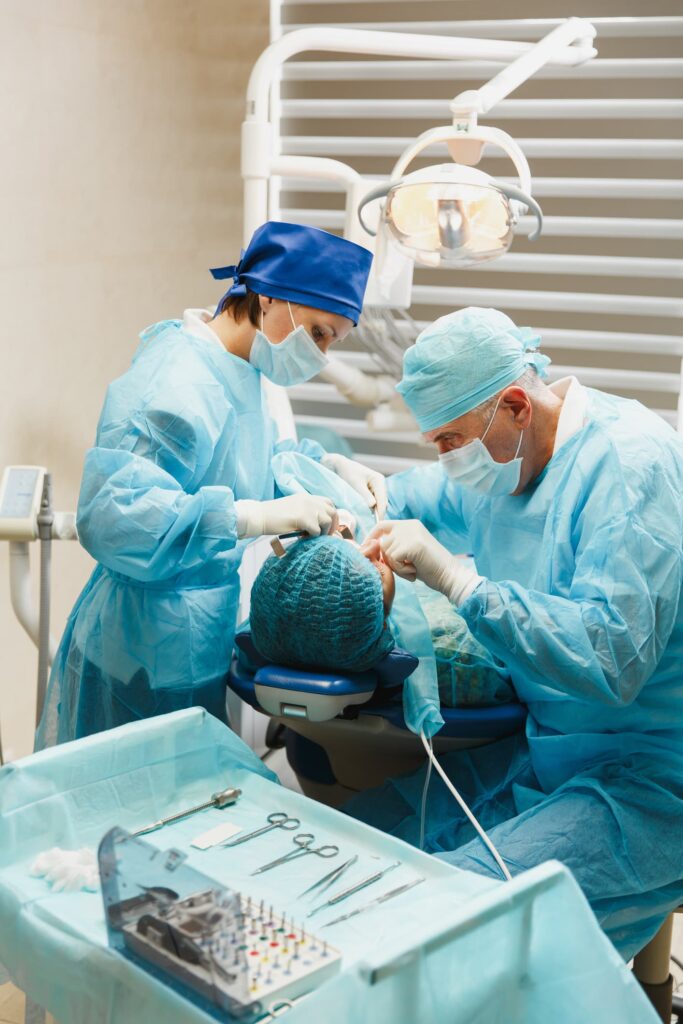
Dissolvable dental stitches at Azalea Dental are specialized surgical threads made from biocompatible materials that naturally break down and absorb into your gum tissue over one to two weeks. Unlike regular non-absorbable stitches, they do not require a follow-up dental visit for manual removal. Additionally, medical evidence supports that surgical suturing promotes hemostasis and healing by primary intention to lower bone loss at the surgical site [1] (Davis et al., 2023).
What Do Stitches Feel Like?
When you have dental stitches, it usually feels like you have a tiny piece of food permanently stuck between your teeth. You will feel a slight, dull tension pulling your gums together. As your swelling goes down over the first few days, the stitches might even feel a bit loose. The biggest challenge you will face is fighting your own curiosity. Your tongue will naturally want to explore the extraction site and play with the threads. Poking, pulling, or sweeping your tongue over the surgical site can loosen the knot, disrupt your healing blood clot, and delay your recovery.
How to Safely Eat With Dental Sutures in Place
While you already know to stick to a soft-food diet after an extraction, eating with stitches requires a slightly different level of caution. Your goal is to avoid snagging the threads while you chew. Gummy candies, caramel, and tough breads can easily wrap around the stitch and physically pull the knot out of your gums. For the first week, strictly chew your soft foods on the side of your mouth opposite the extraction. Clinical literature also supports advising patients to take a multivitamin during the healing phase, particularly early on [2] (Lau et al., 2013). If food particles do get trapped near the threads, do not use a toothpick to remove them. Simply take a sip of water, gently tilt your head to let it wash over the area, and lean over the sink to let it drain.
Table that compares suture options
Suture category | Cost | Durability | Patient maintenance level |
Dissolvable synthetic PGA | Included in the extraction fee | 10 – 14 days | Low |
Dissolvable natural gut | Included in the extraction fee | 5 – 7 days | Low |
Regular silk and nylon | Included in the extraction fee | Permanent until removed | Moderate |
Why Your Gums Tingle as Stitches Dissolve
By day four or five of your recovery, the sharp soreness of the extraction will be gone. However, you might notice your gums start to feel tight, tingly, or, surprisingly, itchy. This is actually a sign that your body is healing. If Dr. Barbaro placed dissolvable stitches, this itchy sensation means the synthetic material is actively breaking down. As the threads dissolve and your natural gum tissue knits itself back together, the nerve endings in your mouth become highly active. It is vital that you do not rub, scratch, or brush the area aggressively to relieve the tingling. Medical literature supports that scratching can further hinder the wound healing process [3] (Papanikolaou et al., 2025). A simple warm saltwater rinse can safely soothe irritated tissue.
What Happens If You Accidentally Swallow a Dissolvable Stitch?
This is one of the most common panicked questions we get from patients. If you accidentally swallow a dissolvable stitch, you are completely safe. Because these sutures are crafted from biocompatible, medical-grade materials like specialized collagen or polyglycolic acid, they are non-toxic. Your stomach acids will quickly and harmlessly break the tiny thread down, and it will pass through your digestive system without causing any issues.
How Stitches Prepare Your Jaw for Future Implants
Stitches do much more than just close an empty hole in your gums. They are actually the first critical step in protecting the future of your smile. When a tooth is removed, your jawbone can rapidly shrink. To prevent this, Dr. Heinsheimer often places a bone graft into the empty socket immediately after the extraction. Your dental stitches act as a protective seal, locking that vital bone graft material safely inside the jaw while it heals. By holding the tissue firmly in place, the sutures allow your body to generate dense, healthy new bone. This meticulous tissue management ensures that when you are ready to replace the missing tooth, you have a solid, permanent foundation.
FAQS
1. Do stitches need to be removed after a tooth extraction?
If Dr. Barbaro uses dissolvable stitches, no removal is required; they will melt away on their own within one to two weeks. If regular (non-absorbable) stitches are used, you will need to return to our clinic for a painless 5-minute appointment to have them removed.
2. What happens if a dental stitch falls out early?
It is completely normal for a dissolvable stitch to loosen or fall out on day three or four as the swelling goes down and the material begins to break down.
3. Can I brush my teeth if I have stitches?
Yes, but you must be incredibly gentle. You cannot brush directly over the stitches or the extraction site for the first few days, as the bristles can snag the thread.
References
[1] Davis B, Smith KD. Oral Surgery Suturing. [Updated 2023 May 29]. In: StatPearls [Internet]. Treasure Island (FL): StatPearls Publishing; 2026 Jan-. Available from: https://www.ncbi.nlm.nih.gov/books/NBK572089/
[2] Lau, B. Y., Johnston, B. D., Fritz, P. C., & Ward, W. E. (2013). Dietary strategies to optimize wound healing after periodontal and dental implant surgery: an evidence-based review. The open dentistry journal, 7, 36–46. https://doi.org/10.2174/1874210601307010036
[3] Papanikolaou, M., Paul, J., Nattkemper, L. A., Kirsner, R. S., & Yosipovitch, G. (2025). Prevalence and Mechanisms of Itch in Chronic Wounds: A Narrative Review. Journal of clinical medicine, 14(9), 2877. https://doi.org/10.3390/jcm14092877